
Clothing
Start with socks.
My daughter has one pair of socks she actually likes. Rubber ridges on the sole, from the trampoline park, and she keeps them on long after we are home.
One child, one pair of socks
This is an observation, not a finding.
One child liking one thing tells you almost nothing. It is a thread worth pulling, not a product.
Before we make anything, we want to know whether this is common. Whether other families have found the same, or found the opposite. Whether what helps is the texture underfoot, the pressure, the seam across the toes, or something we have not thought to ask about. That feels like a proper piece of research, and not something we could work out on our own. If any of it has already been looked into, we would much rather learn from it than start over, so if you know of something, please do point us in the right direction.
Where we are starting from
Clothes come with assumptions built in.
All of this starts with one child, in one house. We have not surveyed anyone, and we are not going to write "parents tell us" until parents have actually told us. What follows is what we have run into ourselves, and what we think the problem might be. If it looks different in your house, we would love to hear about that.
The label in the back
Cut out before it is worn
Labels, chunky seams and stiff embroidery sit against the skin all day. For a child who feels that sharply, a top can be unwearable before it has been worn once.
Buttons, zips, laces
Designed for other hands
Buttons, zips and laces take a certain amount of dexterity, and take it standing up, in a hurry, on a school morning.
Told another way
Not every answer is spoken
A child who cannot say that a waistband is digging in will let you know some other way. They are telling you something. The job is to work out what, and then take the waistband out of the equation.
Size up, make do
Bought three, kept one
Finding something that actually gets worn can mean buying the same thing more than once, in different sizes or cuts, and altering it anyway.
Finding it again
The reorder that is not the same
When something finally works, you want five more. A quiet change to the fabric or the seam can make the next one unwearable.
Room to choose
The list gets short quickly
Once comfort has to come into the decision, the number of things that work can fall away fast. There is no reason that list has to be as short as it often is.
If we make anything, they have to want to wear it.
Most children have a favourite something. The jumper that goes on first and comes off last, the joggers that cause a row on wash day. We would love to make something that stands a chance of being that, for whoever ends up wearing it, and we would like the comfort side of it to be the quiet part, the bit nobody has to think about.
Flat seams, no scratchy label, a soft waistband, a hood with room for ear defenders. None of that needs to show, and none of it should limit what the thing can look like, or how much there is to choose from. If we get it right, it is just a jumper somebody loves.
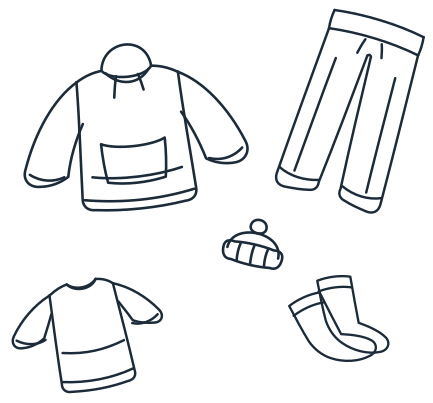
Before anything is made
What we need to find out.
Whether the socks mean anything
One child at a trampoline park is an anecdote. We want to know whether other families have noticed the same, and what they think is actually helping.
Which problem comes first
Labels, waistbands, fastenings, fit, getting changed. They are not equally urgent, and we would rather solve one properly than six badly.
How we test it, and with whom
We would rather put samples in the hands of a group of families and let them live in them for a few weeks. What still gets worn at the end of that tells us more than any survey would.
Whether it can be made here
Small runs, consistent fabric, repeatable seams. We need to know what is possible before we describe any of it to anyone as a plan.
Making it
We would like to make it in the UK.
We are starting conversations with UK manufacturers. The kind who take on small runs, pattern work and samples.
If you make clothes, cut patterns, know fabric, or have done adaptive or sensory work before, we would like to talk to you. The same goes if you have done none of that and simply know who we ought to be speaking to.
We are early, and a good conversation would be worth a great deal to us right now. Tell us what is possible, what is not, and what we have not thought of. If you have ever wanted to put your trade behind something like this, we would love to hear from you.
What this page is not.
It is not a shop
There is nothing to buy, no waiting list for a garment, and no date. If that ever changes, it will be obvious.
It is not advice
We are only describing what one family noticed. Every child is different, and you will know your own far better than we ever could.
It is not settled
Clothing may end up part of ARI, alongside it, or not happen at all. We would rather think out loud while we work that out.
Does your child have a pair of socks?
The one thing they will wear when nothing else works. A jumper, a particular pair of joggers, shoes a size too big. Whatever it is, it is worth more to this than any brief we could write.
Please do not send us anything about your child's diagnosis or needs. It is the garment we are interested in, and anything you can tell us about why that one works.