
The journal
The day, in your own words.
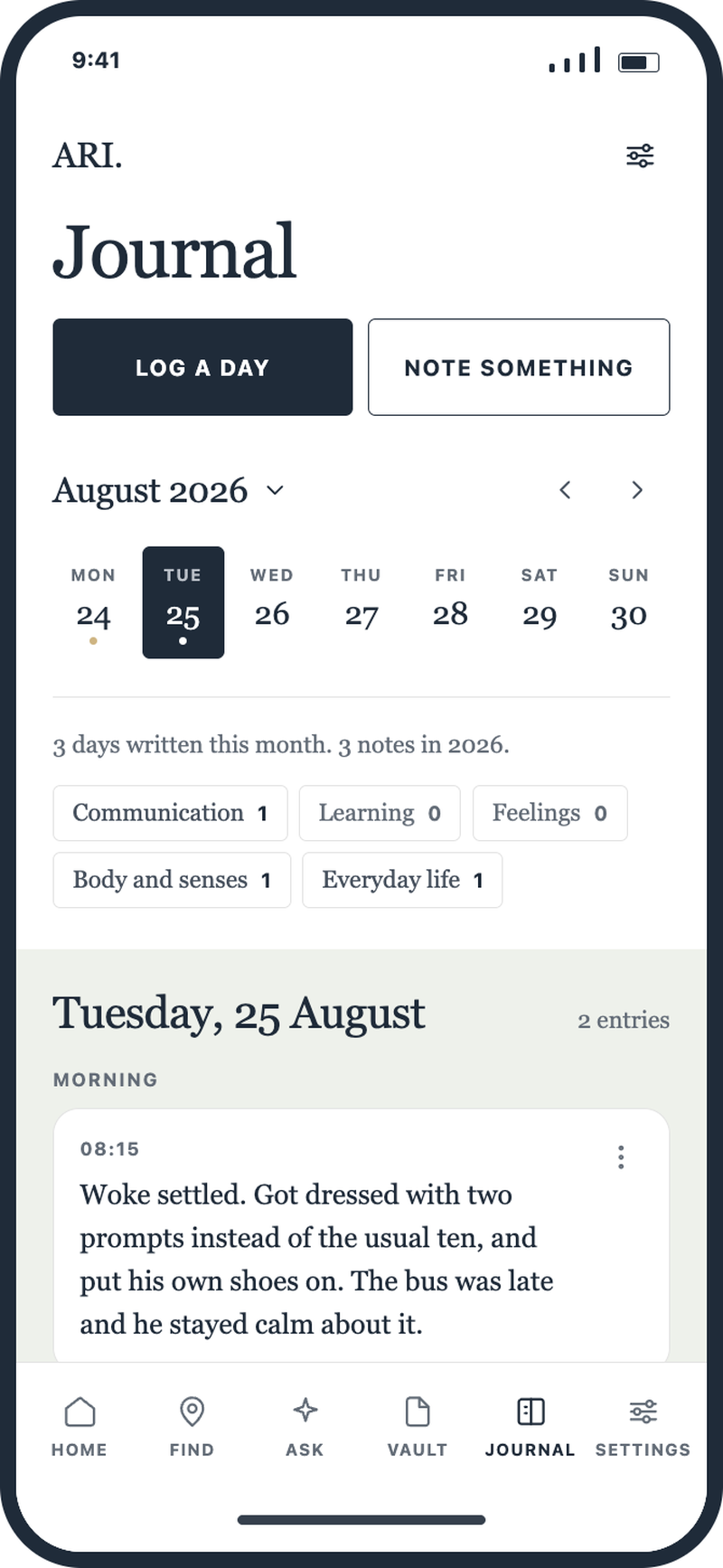
Some days you want a line about how it went. Some days it is one thing your child did that nobody else was there to see. The journal is our idea for somewhere to put both, on the days you have a minute for it.
None of it is built. What follows is the thinking, put out early so you can tell us which parts matter and which are beside the point.
Why this matters
Three things get lost between appointments.
On an ordinary day
The bit nobody was there for
A first word at the kitchen table. A day that turned, for a reason you spotted. It matters, and by Thursday it is gone.
Asked about it later
Six months, in ten minutes
An appointment asks how things have been since March. Remembering that in a waiting room is a different job from having written it down.
It has to be quick
A line is plenty
Anything that feels like a form to fill in gets dropped within a fortnight. This has to survive a hard week or it is not worth building.
One idea, in more detail
Two ways to write, on purpose.
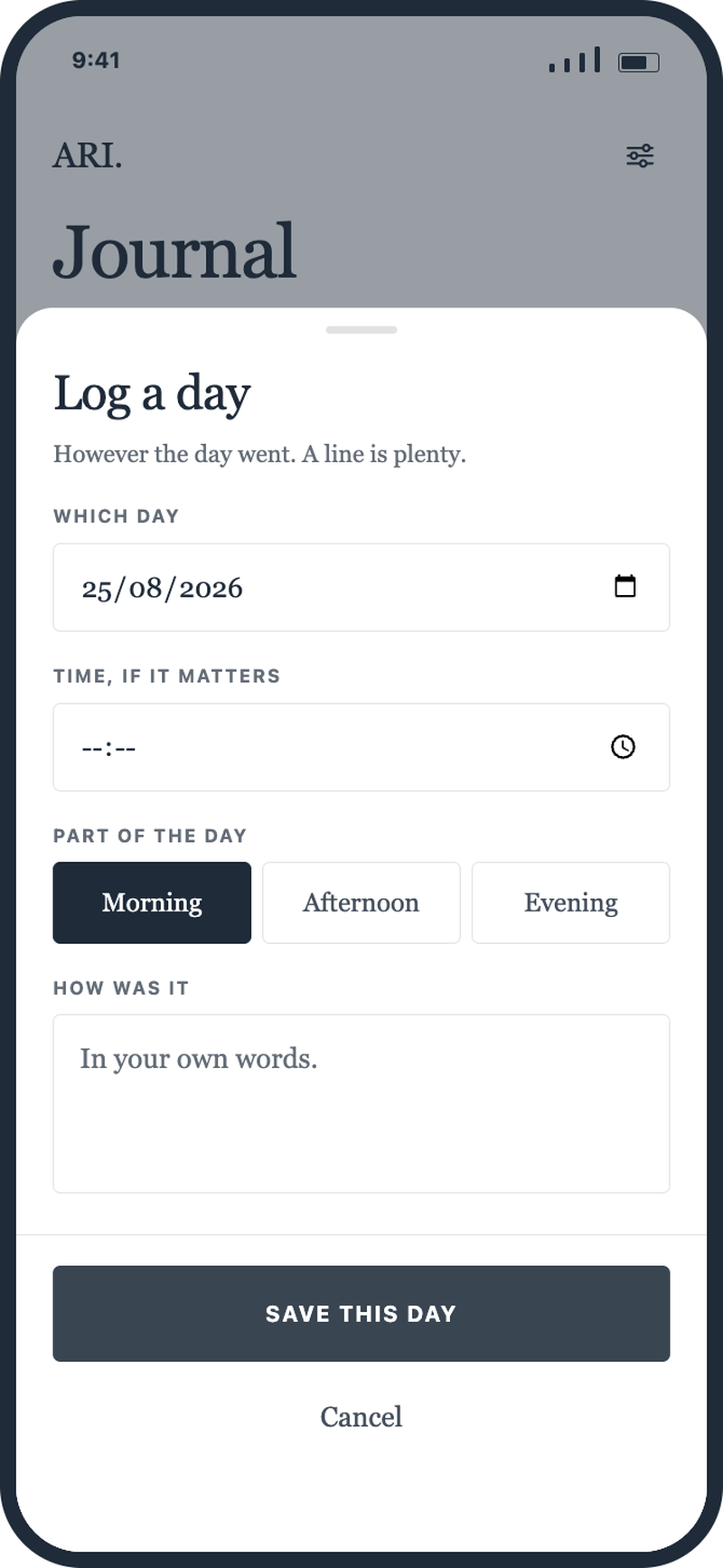
One is an account of a day: how it went, filed under the morning, the afternoon or the evening, as many times as the day needs. The other is one thing you noticed, filed under the day it happened so it can be found again years later.
Keeping the two apart is deliberate. They get written at different moments, and they get looked for in completely different ways.
Early thinking
Ideas we are weighing up.
These are the ideas we keep coming back to for the journal. None of them are built, which is why setting them out together makes it easier to say which ones matter.
Some of them we have thought about a great deal more than others. Tell us whether the journal is what to build first.
Writing it down
However the day went
A line is plenty. The morning and the afternoon kept apart, because a good start and a hard finish are both worth having.
Writing it down
One thing you noticed
Something your child did that you want kept. Filed under the day it happened, not the day you got round to writing it.
Writing it down
Written when you remember it
Back-date it freely, and the time stays optional. Somebody writing up last Tuesday may remember the morning and not the hour.
Saying what kind
Five plain words, not a form
Communication, learning, feelings, body and senses, everyday life. Noticing a first word should not mean reaching for the vocabulary of a hearing.
Saying what kind
No box marked other
A catch-all ends up holding whatever was hardest to describe, which is usually the part worth keeping.
Speaking it
Speaking instead of typing
Say it while the kettle boils, and the words are what gets kept rather than the recording. On a phone that cannot do that without sending your voice away, it would not listen at all.
Finding it again
The day you half remember
A month at a glance, marking the days that have something written, so you can go straight to the one you are thinking of.
Finding it again
Notes that keep
Grouped by month and going back as far as you have written. The whole value of noticing something is being able to find it later.
Finding it again
A stretch of time, read in one go
Months pulled together into something you can read before an appointment. A starting point for the conversation, never a record that settles anything.
Still open questions
A photograph with the entry
Sometimes the thing worth keeping is a picture rather than a sentence.
Still open questions
A voice note kept as a voice note
A different question from speaking instead of typing, and a bigger one. Keeping the audio means keeping your child's voice, which is not a thing to add lightly.
What this is not.
Not a score
Nothing here would count what you did not write. No streaks, no targets, no setting this month against last one. A week with nothing in it is just a week.
Not a medical record
What you write is yours, in your own words. It is not a diagnosis and it is not written in the language a clinician or a panel would use.
Not something we would share
Sharing would always be something you switch on, for a named person, for a set length of time, and switch off again.
Not ours to keep
The thinking is that what you write stays on your phone, and that anything you put in comes out again in a form you can read without ARI.
This site collects an email address and a first name, and nothing about your child. Here is exactly what we hold and why.
One app. One community.
Would you use this?
The journal is one of the things we could build first, and there are more ideas here than we can do well at once. Knowing whether this is the one that would change a week for you is the most useful thing you can tell us right now.
No need to tell us anything about your child. It is the idea we are asking about.